Sunday, February 22, 2009
Replacing Bolts at La Cueva
I replaced a few of the old bolts that we used on my last trip to La Cueva. I replaced both the bolts at the top of "Swainson", and I replaced the Bolt at the top of "Nothing to Prove". I used redhead Concrete expansion bolts and Metolius hangers. These aren't the botls you get from climbing gear suppliers, but a more run-of-the-mill hardware store style. Still, they are rated to 1500 lbs. It felt good to be out after being imprisoned at WSTF by the MEASAT program, even if I was only out by myself for a few hours to drill some bolts.

Saturday, January 3, 2009
La Cueva: West End short-lines
The OMTRS had a training out at La Cueva today which consisted of setting anchors and rappelling/ascending a fixed line. We set up lines on the "Training Wall", a short rotten cliff formation off to the NW of the west end of the main La Cueva rocks. I brought my climbing gear with me and set up a top-rope on Swainson while the rest of the team was getting situated. After people had had enough of placing gear, they took a try on the top-rope. It's been almost three years since I first climbed this Top-rope. This time, I backed up the old 1/4" bolts with a pair of tri-cams. My maxim is "When climbing with the OMTRS, be extra safe". Even with this creed, climbing around the OMTRS still makes me feel inadequate safety-wise. I think this is partly because people sometimes put a lot of trust in my gear and anchors because I have a reputation as a climber. Regardless, several people tried Swainson and no one could figure out the moves. I didn't remember the route being that tricky, but I was beginning to doubt my memory. Memory also has a funny way of messing with your mind. I alos started thinking that maybe I was in better climbing shape back then, even though when we first got to Cruces, it had been almost a year since I had climbed. I eventually got a turn on Swainson and zipped right up it. I still would call the route a 5.9+. It's good to know that I've maintained some kind of consistency throughout my years here.
At around 2pm, the rescue team was hiking out, leaving Bob Cort and myself behind. Bob's been dropping hints about wanting someone to take him climbing at the last few missions, and I was gung-ho to climb today, so we made a good pair. Together we knocked out 6 more short routes in the area, none of which I had climbed before.
Route : Kestrel
Length: 30 ft
Rating: 5.6
Protection: Ample. Not very good gear for the anchor though. I was able to use the tricams that were already in place for the Top-rope of Swainson which saved me some time. A bolt at the top would be nice.
Description:The first route we tackled was the short crack system just to the left of Swainson. I had nearly soloed up this entire route while other were climbing Swainson, but decided it would be better to wait for a belayer. The crack is pretty short, and has two large pods which make it distinctive. I stuffed my new #5 camelot in the bottom pod. The second pod took a cam at the bottom, and then I finagled a pink tricam into a pocket above the pod. The final moves exiting the last pod are the most exposed (the ones I didn't want to solo) and I managed to get another small cam in a pocket to protect this move. Bob found the start to be the hardest moves. The first pod is right-leaning and awkward to pull into. He cruised the rest of the route and even was able to get out a very firmly placed tri-cam.
Route : Peregrine
Length: 30 ft
Protection: Difficult to build anchor.
Rating: 5.11
Description: After climbing Kestrel, I wanted to set-up a top-rope on a steep crack-seam just a little bit further east. The top of this route is a nice ledge with a small tree, but not much for gear placements. Luckily, my #5 camelot fit at the very back of the ledge and provided the foundation for our top-rope anchor. I supplemented this cam with two tri-cam placements and use dup almost all the extenders I had in order to have our rope be close to the edge. The route is as hard as it looks. It might be leadable, but is more like a high-ball boulder problem. I started it by lay-backing the seam for about 15 ft. The lay-back petered out and I found myself transitioning to some suspect face holds. The seam is a shallow corner at this point and I was able to stem myself up another 10 ft until I could make a reach out right to a sharp finger jam. If I was to lead the climb, it would almost make the most sense to simply boulder up until you get place a wire in this hold. Only the final moves would be protected, and you could take a pretty big fall. The landing is flat though, but it would still take a lot of guts. The sharp finger jam is bomber, but also very painful. I matched my left hand just above it, shuffled feet around, then reached a second sharp finger jam. This one was not quite as good, but still quite painful. From these holds I was able to pull up and top-out. Bob was able to get up the lay-back section but was stymied by the stemming section. We opted to scramble around to clean the anchor and find the next climb rather than tire ourselves out on this one any more.
There were a few possible routes to the left of Peregrine. Just to the left is the slab that we climb to get to the Tyrolean low-point ledge. Next to this is a very loose looking chimney. Around the corner to the left were two left-sloping crack systems which looked like good rock. These were our next two climbs.
 Route : Proving Ground
Length: 50-60 ft depnding on finish
Rating:5.7
Protection: Ample. I used my #5 camelot again but I could have just has easily found a spot deeper in the crack that would have worked. I placed 3-4 more pieces up the route, including a suspect red-TCU in a pocket for the variation finish.
Description: To gain the crack system, I first had to climb up a 10 ft low-angle face. This was the 5.7 section, and while not that difficult, I had to make a conscious effort to avoid to rotten looking holds. Bob popped a couple of these off while seconding. Once I gained the crack, I was able to place some gear, and the rock quality seemed to improve somewhat. The wide crack seemed to be more of a hindrance than anything, keeping me off balance as I climbed up the ramp on good positive holds. The crack does supply ample protection though. I topped out, but didn't find any fixed gear for anchors. Instead of simply building an anchor right there though, I down-climbed 10 ft, and then climbed up an exposed face to the right of the crack. This gains a higher summit, and I build a nice anchor with large stoppers and a big cam. I belayed Bob from this hanging belay. To descend, I lowered Bob off, cleaned the anchor, and down-climbed the ridge a little bit to the east where I remembered a piton rappel was found. I backed up the piton and had Bob lower me off. PHOTO: Me at the top of the variation finish. Most of the route is not visible.

 Route: Nothing to prove
Length: 50 ft
Rating: 5.5
Protection: Good. I used the #5 camelot again at the crux down-low. Bob noticed that half-way up was a 1/4" bolt stud (no hanger or nut). The top anchor can use the piton and another 1/4" bolt stud.
Description: I pulled th rope down and led up this crack. I remember trying this route solo once, back when the OMTRS did the Tyrolean last year. I didn't get past the first crux, which was a wide section of the crack at an awkward bulge. There are face holds which can be used, but they looked rotten to me and not worth soloing on. Today I had a rope though, and did not hesitate up the crack. I still avoided the rotten looking holds, favoring a chicken wing in the crack instead. I think this may make the route feel a little harder, but Bob showed me that using the holds was quite acceptable (they didn't break at least) and made the moves more straight-forward. After this first crux, the rest of the climb is extremely easy. It left me wondering why someone had even bothered placing the 1/4" bolt at the mid-point. PHOTO: Bob Cort in Blue and myself in Red
It was now 4pm, and I offered to pack it in for the day. Bob rebutted that he still ahd some climb in him, so we walked a short ways east to the next good-looking routes. We passed up the short 5.4s that I've soloed to gain the summit ridge before. These are a good option for descent if you don't want to rappel off the piton on the previous routes.
Route: B-Route
Length: 45 ft
Rating: 5.5
Protection: Sparse. Only two small gear placements before I got to the top of the seam.
Description: This route and the next converge at the same point about 40 ft up. The start is very low-angled, so my first protection was about 20 ft up. The route is a left-leaning crack on the low-angled face. At the top of the crack, a small chute/chimney gains a ledge at the top. Good face holds were present along the hole climb, but there were also lots of rotten holds that I tried to avoid. A built an anchor with two ssmll wires and a 0 TCU. I looked around for some fixed gear but didn't see anything. I belayed Bob from the ground and he cruised the route.
 Route: A-Route
Length: 45 ft
Rating: 5.6
Protection: Sufficient. This crack offered more options and with more frequency than its neighbor. It also had more animal scat in it.
Description: This was the left-hand crack of the two cracks that make an "A". It felt slightly steeper, and slightly more challenging, as the left-hand wall made one have to think about one's balance a little more. Again, I did not protect until about half-way up. The rock was similar, ample positive holds, but many of them suspect looking. I tried my best to tip-toe up. PHOTO: Me on "A"-route
Since I hadn't seen any fixed gear, we had a scheme worked out for the descent. I was to lower Bob off, then clean the anchor. Bob would put me on belay and I would down-climb the ridge to the 5.4 down-climb route, staying on the far (south) side of the ridge so that if I fell, I would fall on the opposite side and Bob could catch me. Turns out this was unnecessary, after down-climbing a few moves I discovered two shiny 3/8" bolts with rappel rings on them.
 It was then 5pm, and the park was closing. Since I know Bob checks this blog, thanks again for climbing with me today. I've been wanting to jump on those routes for a while. And there's plenty more at La Cueva to try out for the next time. Also thanks for taking all these pictures. All pictures on this blog and the MP.com pages were taken by Bob. It seems that unless I have someone else to be photographer, I don't end up with many graphics to supplement my rambling route descriptions.
At around 2pm, the rescue team was hiking out, leaving Bob Cort and myself behind. Bob's been dropping hints about wanting someone to take him climbing at the last few missions, and I was gung-ho to climb today, so we made a good pair. Together we knocked out 6 more short routes in the area, none of which I had climbed before.
Route : Kestrel
Length: 30 ft
Rating: 5.6
Protection: Ample. Not very good gear for the anchor though. I was able to use the tricams that were already in place for the Top-rope of Swainson which saved me some time. A bolt at the top would be nice.
Description:The first route we tackled was the short crack system just to the left of Swainson. I had nearly soloed up this entire route while other were climbing Swainson, but decided it would be better to wait for a belayer. The crack is pretty short, and has two large pods which make it distinctive. I stuffed my new #5 camelot in the bottom pod. The second pod took a cam at the bottom, and then I finagled a pink tricam into a pocket above the pod. The final moves exiting the last pod are the most exposed (the ones I didn't want to solo) and I managed to get another small cam in a pocket to protect this move. Bob found the start to be the hardest moves. The first pod is right-leaning and awkward to pull into. He cruised the rest of the route and even was able to get out a very firmly placed tri-cam.
Route : Peregrine
Length: 30 ft
Protection: Difficult to build anchor.
Rating: 5.11
Description: After climbing Kestrel, I wanted to set-up a top-rope on a steep crack-seam just a little bit further east. The top of this route is a nice ledge with a small tree, but not much for gear placements. Luckily, my #5 camelot fit at the very back of the ledge and provided the foundation for our top-rope anchor. I supplemented this cam with two tri-cam placements and use dup almost all the extenders I had in order to have our rope be close to the edge. The route is as hard as it looks. It might be leadable, but is more like a high-ball boulder problem. I started it by lay-backing the seam for about 15 ft. The lay-back petered out and I found myself transitioning to some suspect face holds. The seam is a shallow corner at this point and I was able to stem myself up another 10 ft until I could make a reach out right to a sharp finger jam. If I was to lead the climb, it would almost make the most sense to simply boulder up until you get place a wire in this hold. Only the final moves would be protected, and you could take a pretty big fall. The landing is flat though, but it would still take a lot of guts. The sharp finger jam is bomber, but also very painful. I matched my left hand just above it, shuffled feet around, then reached a second sharp finger jam. This one was not quite as good, but still quite painful. From these holds I was able to pull up and top-out. Bob was able to get up the lay-back section but was stymied by the stemming section. We opted to scramble around to clean the anchor and find the next climb rather than tire ourselves out on this one any more.
There were a few possible routes to the left of Peregrine. Just to the left is the slab that we climb to get to the Tyrolean low-point ledge. Next to this is a very loose looking chimney. Around the corner to the left were two left-sloping crack systems which looked like good rock. These were our next two climbs.
 Route : Proving Ground
Length: 50-60 ft depnding on finish
Rating:5.7
Protection: Ample. I used my #5 camelot again but I could have just has easily found a spot deeper in the crack that would have worked. I placed 3-4 more pieces up the route, including a suspect red-TCU in a pocket for the variation finish.
Description: To gain the crack system, I first had to climb up a 10 ft low-angle face. This was the 5.7 section, and while not that difficult, I had to make a conscious effort to avoid to rotten looking holds. Bob popped a couple of these off while seconding. Once I gained the crack, I was able to place some gear, and the rock quality seemed to improve somewhat. The wide crack seemed to be more of a hindrance than anything, keeping me off balance as I climbed up the ramp on good positive holds. The crack does supply ample protection though. I topped out, but didn't find any fixed gear for anchors. Instead of simply building an anchor right there though, I down-climbed 10 ft, and then climbed up an exposed face to the right of the crack. This gains a higher summit, and I build a nice anchor with large stoppers and a big cam. I belayed Bob from this hanging belay. To descend, I lowered Bob off, cleaned the anchor, and down-climbed the ridge a little bit to the east where I remembered a piton rappel was found. I backed up the piton and had Bob lower me off. PHOTO: Me at the top of the variation finish. Most of the route is not visible.

 Route: Nothing to prove
Length: 50 ft
Rating: 5.5
Protection: Good. I used the #5 camelot again at the crux down-low. Bob noticed that half-way up was a 1/4" bolt stud (no hanger or nut). The top anchor can use the piton and another 1/4" bolt stud.
Description: I pulled th rope down and led up this crack. I remember trying this route solo once, back when the OMTRS did the Tyrolean last year. I didn't get past the first crux, which was a wide section of the crack at an awkward bulge. There are face holds which can be used, but they looked rotten to me and not worth soloing on. Today I had a rope though, and did not hesitate up the crack. I still avoided the rotten looking holds, favoring a chicken wing in the crack instead. I think this may make the route feel a little harder, but Bob showed me that using the holds was quite acceptable (they didn't break at least) and made the moves more straight-forward. After this first crux, the rest of the climb is extremely easy. It left me wondering why someone had even bothered placing the 1/4" bolt at the mid-point. PHOTO: Bob Cort in Blue and myself in Red
It was now 4pm, and I offered to pack it in for the day. Bob rebutted that he still ahd some climb in him, so we walked a short ways east to the next good-looking routes. We passed up the short 5.4s that I've soloed to gain the summit ridge before. These are a good option for descent if you don't want to rappel off the piton on the previous routes.
Route: B-Route
Length: 45 ft
Rating: 5.5
Protection: Sparse. Only two small gear placements before I got to the top of the seam.
Description: This route and the next converge at the same point about 40 ft up. The start is very low-angled, so my first protection was about 20 ft up. The route is a left-leaning crack on the low-angled face. At the top of the crack, a small chute/chimney gains a ledge at the top. Good face holds were present along the hole climb, but there were also lots of rotten holds that I tried to avoid. A built an anchor with two ssmll wires and a 0 TCU. I looked around for some fixed gear but didn't see anything. I belayed Bob from the ground and he cruised the route.
 Route: A-Route
Length: 45 ft
Rating: 5.6
Protection: Sufficient. This crack offered more options and with more frequency than its neighbor. It also had more animal scat in it.
Description: This was the left-hand crack of the two cracks that make an "A". It felt slightly steeper, and slightly more challenging, as the left-hand wall made one have to think about one's balance a little more. Again, I did not protect until about half-way up. The rock was similar, ample positive holds, but many of them suspect looking. I tried my best to tip-toe up. PHOTO: Me on "A"-route
Since I hadn't seen any fixed gear, we had a scheme worked out for the descent. I was to lower Bob off, then clean the anchor. Bob would put me on belay and I would down-climb the ridge to the 5.4 down-climb route, staying on the far (south) side of the ridge so that if I fell, I would fall on the opposite side and Bob could catch me. Turns out this was unnecessary, after down-climbing a few moves I discovered two shiny 3/8" bolts with rappel rings on them.
 It was then 5pm, and the park was closing. Since I know Bob checks this blog, thanks again for climbing with me today. I've been wanting to jump on those routes for a while. And there's plenty more at La Cueva to try out for the next time. Also thanks for taking all these pictures. All pictures on this blog and the MP.com pages were taken by Bob. It seems that unless I have someone else to be photographer, I don't end up with many graphics to supplement my rambling route descriptions.
Sunday, December 28, 2008
Pena Blanca: Romantic Spy Boulder
Liz took me climbing again, this time we played on a boulder in the Garden area of Pena. There are 5 routes described on the Romantic Spy boulder. I tried 4 of them, and managed to send 3. I spent most of the time working X Spy. This is a short problem that involves finding some beta to get from two holds on either side of a protrusion, to a much higher hold. Right off the bat I could get high feet and would be able to reach the higher hold, but the high feet made the two starting holds very awkward to hold onto, because they are both essentially side pulls. I tried dynos from this position, but they didn't work for me. Eventually, I found a sequence that worked for me which involved a particular foot-work sequence and knee-scum.

Aaron's X Spy Beta:
Liz took all sorts of pictures and video of me working this. For fun, I stitched it into a video to put on our Family Blog. *I forgot that the "hobsonian" is invite only. I'm posting the video here*

The other problem that I spent some time working was Spy v Spy. I couldn't figure this one out. As far as I could get was pressing into an awkward face-smear. Somehow, you can make a big move to a good hold at the lip. My favorite two words, "Next time..."


Aaron's X Spy Beta:
- Grab the two starting holds.
- Pull up and get both feet high, basically right at the bottom of the protrusion
- Move the right foot over to a hold at the same level but further to the right.
- Twist right leg so that the right knee can be pressed into (or near) the right hand. It's almost a knee bar, but more like a knee scum.
- Using the knee-scum for some extra balance, reach up with right hand and grab the big hold at the top-right side of the "X".
Liz took all sorts of pictures and video of me working this. For fun, I stitched it into a video to put on our Family Blog. *I forgot that the "hobsonian" is invite only. I'm posting the video here*

The other problem that I spent some time working was Spy v Spy. I couldn't figure this one out. As far as I could get was pressing into an awkward face-smear. Somehow, you can make a big move to a good hold at the lip. My favorite two words, "Next time..."

Saturday, December 27, 2008
Organ Mtns: Barbs Buttress in the Cold
Liz had to do some school-work today so I took the dog and the climbing gear and hiked up into Rabbit Ears Canyon. I wanted to jump on something slabby on Barb's Buttress, so despite the cold wind coming down the canyon and a light dusting of snow visible on the slab, I made right for it. During the winter, this slab gets very little sun, and the wall was still ice-cold when I reached it. The ledges and positive holds were slightly snow covered, appearing almost liked overly chalked up holds. I picked what looked to be one of the easiest routes on a slab to the left of where Scott and I climbed almost a year ago. Since Sasha isn't such a good belay partner, I took out the old Wren Soloist.
Route Description
Name: Un-known. For now let's call it Cruise Control
Length: ~60m. I only got about 30m up which is the height of the corner route directly to its left. The slab appears to extend for another 30 m, with potential crack systems for protection.
Protection: The bottome had nice cracks to protect in. About 40 ft up is a ledge. An option to the left follows some cracks and joins up with the top of the corner route on the left. I chose the option on the right. This one has 10-15 ft slab/face moves between protection. I ended up rapping off a block at 30m because my hands were frozen solid. An interesting note is that the point where I rapped can be reached by scrambling up the gully behind the wall and popping out around onto the face. I was able to retrieve my rappel gear this way.
Rating: Probably a 5.5 with pg13 protection. The upper section looked a little more lichen covered and it was less obvious that there would be protection up there.
Jumping on this route was remiscent of winter climbing. I'd reach up for the next hold and it would have snow on it. My fingers would freeze as I climbed high enough to get my feet up, then I'd get snow on my climbing shoes and they'd feel slick for the next few moves. This wasn't too bad for the start which had good protection, but when I got higher and the protection became scarcer, I wasn't too happy with this situation. Not one to take crazy risks on my soloist, I found a good rappel spot that happenned to be about half a rope length.
Next time: I'd like to climb the corner route which looks like a low-angled off-width. There was also a route marked by a piton in a steep seam just to the left of the corner which looked promising. The start looked cruxy, but the slabs above are what would worry me, because from a distance they do not look very protectable. An option would be to climb a different crack to the left of this and then rappel the route to see if it is protectable.
Route Description
Name: Un-known. For now let's call it Cruise Control
Length: ~60m. I only got about 30m up which is the height of the corner route directly to its left. The slab appears to extend for another 30 m, with potential crack systems for protection.
Protection: The bottome had nice cracks to protect in. About 40 ft up is a ledge. An option to the left follows some cracks and joins up with the top of the corner route on the left. I chose the option on the right. This one has 10-15 ft slab/face moves between protection. I ended up rapping off a block at 30m because my hands were frozen solid. An interesting note is that the point where I rapped can be reached by scrambling up the gully behind the wall and popping out around onto the face. I was able to retrieve my rappel gear this way.
Rating: Probably a 5.5 with pg13 protection. The upper section looked a little more lichen covered and it was less obvious that there would be protection up there.
Jumping on this route was remiscent of winter climbing. I'd reach up for the next hold and it would have snow on it. My fingers would freeze as I climbed high enough to get my feet up, then I'd get snow on my climbing shoes and they'd feel slick for the next few moves. This wasn't too bad for the start which had good protection, but when I got higher and the protection became scarcer, I wasn't too happy with this situation. Not one to take crazy risks on my soloist, I found a good rappel spot that happenned to be about half a rope length.
Next time: I'd like to climb the corner route which looks like a low-angled off-width. There was also a route marked by a piton in a steep seam just to the left of the corner which looked promising. The start looked cruxy, but the slabs above are what would worry me, because from a distance they do not look very protectable. An option would be to climb a different crack to the left of this and then rappel the route to see if it is protectable.
Thursday, December 25, 2008
Christmas Day Bouldering: Pena Blanca

 Liz and I wanted to go for a hike with the dog, and the hike turned into a bouldering session for me. It's been a while since Liz came bouldering with me and with her as photographer, I actually have a number of decent pictures. We went to the Asian Boulders at Pena Blanca, and I tried some of the steeper lines that I wasn't too bold to try last time without a spotter. I still wasn't too bold on them, but had a good time none-the-less.
Here's me trying a "Annihilator". Lowell rates this V5 with a sit-down start. I didn't try the sit-down start, nor the top-out which looked like small holds over a bad landing. But the middle was fun.


And here's a traverse with Sasha spotting me.


I spent a while on "Asian School Girls", a V7 around the corner. The starting moves were really fun to puzzle out, and involved a diagonal slot which I had to transition from a side-pull to an undercling as I moved up on it. The top of the problem looked like the hard stuff, tiny crimps the rest of the way up.
I flashed the V2 that I did last time I was here. Then after working the other problems, I got back on the V2 for a photo and couldn't send it any more. Bouldering is hard for me like that. When I'm fresh out, I can hit moves relatively easily even without warming up. Once I'm "warm" I can no longer hit the moves. There was nothing terribly pumpy about the V2, it was mostly technical with tricky feet, but I somehow couldn't repeat it.
Sunday, December 21, 2008
The Tooth: Tooth Fairy for Hannukah
After the marathon rescue a few weeks ago, I was a little surprised that Ben Nadler was ready to go climbing with me again. This time, we chose a crag closer to the Organ Needle, so when the rescue call goes out we would be there already. It was a perfect day, cool and sunny, and perfectly warm. The approach up to the Tooth was a breeze, even with three dogs in tow. Ben brought his heeler-mutts Dyna and Mo so Sasha was in good company. We decided on climbing Tooth Fairy, mainly because it offered quality crack climbing and Ben seems to think cracks are the only thing worth climbing. Ben took the first lead, taking the standard start up the 5.8 crack. He cruised the pitch, even with terrible rope drag. I've done this pitch before, and should have danced up it, but the 5.9 corner crack caused me to hesitate. I racked up for the crux second pitch which also happens to be the most beautiful pitch of the climb. I don't remember this pitch being run-out, or all that difficult, but I was sweating it today. Before launching into the crux slab moves to establish myself into the crack seam, I must have stared at the wall for a good 5 minutes, thinking "how did I do this before". Eventually I gave up trying to remember and just climbed it, and the moves all became apparent as I reached them. When I got into the seam though, I found it difficult to place some gear. The start of the crack is a very shallow "two-finger" crack. I foolishly tried to through in some cams, and all the placements sucked. I wasn't on a good stance and was starting to sweat more as I fiddled with gear. I could throw out the excuse of using Ben's rack which was unfamiliar to me, but really I should have seen that a large wire-stopper would have been easy to place and just thrown one in. In stead, my arms started getting juiced and I labored up the crack, finally reaching the hand-jams and a good rest. A year after first climbing the route, where's my nerve, and climbing sauviness?
 Fortunately for me, Ben took the last lead. The last pitch fights past a small oak in a crack, and then claws up some grassy cracks to a Sotol yucca. After the Sotol, there is a beautiful finger crack for the final headwall. when I climbed the route previously, I avoided all this by staying to the right on 5.8 grassy cracks. The direct finish is much better, but also stouter. Again I was glad Ben lead the pitch, he made the finger-crack look easy plugging in all sorts of gear. It took a good deal of my effort just to follow cleanly. Tight finger cracks are something I'll have to work on. Ben gave me a tip later which I'll have to try out. Instead of having your body hang off the finger jams, you can apply body tension using your abs to both help your fingers lock into the crack with less effort, and to cause your feet to press against the wall harder, allowing you to feel more stable on smaller foot-holds. Photo: Ben Nadler on the final pitch's finger crack.
We only had one rope to rappel the route, which works, but you have to rely on some sub-par rappel anchors, like 1/4" bolts and angle pitons.
 Fortunately for me, Ben took the last lead. The last pitch fights past a small oak in a crack, and then claws up some grassy cracks to a Sotol yucca. After the Sotol, there is a beautiful finger crack for the final headwall. when I climbed the route previously, I avoided all this by staying to the right on 5.8 grassy cracks. The direct finish is much better, but also stouter. Again I was glad Ben lead the pitch, he made the finger-crack look easy plugging in all sorts of gear. It took a good deal of my effort just to follow cleanly. Tight finger cracks are something I'll have to work on. Ben gave me a tip later which I'll have to try out. Instead of having your body hang off the finger jams, you can apply body tension using your abs to both help your fingers lock into the crack with less effort, and to cause your feet to press against the wall harder, allowing you to feel more stable on smaller foot-holds. Photo: Ben Nadler on the final pitch's finger crack.
We only had one rope to rappel the route, which works, but you have to rely on some sub-par rappel anchors, like 1/4" bolts and angle pitons.
Tuesday, December 9, 2008
Climbing-Rescue Double Header
A couple times this week, I got a call from some climber who got my number from Tom Schuster at the City Hall. I finally got around to calling him back and we arranged to climb Sunday. Turns out Ben Nadler is quite a prolific climber, preferring splitter cracks like Indian Creek and the Basalt columns at Smith Rock. He's also climbed Squamish, Argentina and most of the West's more prominent crags. He's been in Cruces for 9 months now and has yet to get into the Organs, so I took him to Southern Comfort wall which has an easy approach and was fairly warm.
We climbed Black Velvet first and I let Ben lead all the good parts. I haven't fdone this route in a while, but it felt like it could be done in a single long pitch if you take the slab finish instead of the roof traverse. Ben had a 70 m rope but we still broke the climb into three pitches and we never climbed past the half-way point. We took a little lunch break and then I led us up DWI. This route was just my style: easy 5.10 moves, just-enough pro where I felt secure, but spread out enough where I had to focus. It starts up a loose slabby face past 3 bolts to a roof. 2 of th 3 bolts are old button-heads. The move stepping up under the roof was thin and committing but once under the roof I could reach some large jugs above and pull up to a good stance. The route then follows up a thin crack until the crack becomes nothing more than a seam which doesn't take any pro. At that point I made a few moves to the right where I gained another crack which would take some gear. This crack petered out too at a small stance with two bolts (one new one old). Above this bolt looked pretty blank as far as protection was concerned but I could make out a series of face holds which looked pretty good. I followed these up and slightly to the right where it looked like there might be some pro in some diagonal slashes. Turns out there weren't any placements there, but there were some decent rest-stances and I was able to finish up the route with only a marginal small wire for protection during the last 20 ft. Looking at Mountain Project now, it appears I should have gone left at the last bolt and into a small crack system. Next time.

It was about 2 O'clock but Ben wanted to get back into town early so we called it a day and hiked out to the car. While driving down the Topp Hut road, Ben gets a call on his cell-phone from Liz. That made me a little worried, Liz wouldn't normally call a climbing partners phone while we were out unless it was something important. Ben handed me the phone and Liz tells me that there is a rescue Mission call-out and the meeting point is at La Cueva. Convenient that we were already out there. We head over and are one of the first OMTRS members to arrive. The State Police tell us that a 57 year old lady has fallen on the Organ needle trail, somewhere between a formation called "Yellow Rocks" and a saddle commonly known as "Juniper Saddle, which is about 2/3 to the top. Ben has some experience doing rescue missions and decides that helping us out is more important than his previous plans. We gear up for the mission and OMTRS members arrive at the start of the Modoc Mine rd. Ben, John, Grady James and I are assigned to the first team and we're the first to start up as people are trickling in. I guess this is pretty standard procedure for a mission where the subjects' location is pretty well known. A "Hasty team" sets off first carrying only emergency medical equipment and patient care packages. Their goal is to get to the injured subject as quickly as possible, start first aid if necessary and assess what additional rescue equipment will be needed to get the subject out. The rest of the teams bring up the heavy rescue gear as needed. It is about 3:30 when we head out. I am carrying a large but light pack of first aid supplies, neck-braces and warm blankets and pads. It takes us about an hour to reach the subject who was at a steep section of the trail underneath a large riolite rock formation commonly known as "The Grey Eminence". She looked bad, very pale and with dried blood all over her head. Her friend Ilene was with her and was trying to keep her warm. Ilene had gotten the call out around 2 O'clock, and they had been there for over two hours when we arrived and it was starting to get cold. The subject, Trudy, was in no condition to walk. She had sever gashes on here head, had suffered a concussion and injured her shoulder, all from a simple fall on one of the more treacherous sections of the trail.
What happened next blurs together somewhat, as dozens of people arrive and the team is mobilized to extract Trudy on a litter. John and Ben start first aid immediately and get Trudy more comfortable and warm as night falls. By 6 O'clock Trudy has been packaged up on the litter and various teams are scrambling below setting up rappel anchors to help get her down. The kind of extraction we were faced with is called Medium-Angle by experienced rescuers. This means that it is steep enough to make simply carrying of the litter extremely hazardous, but we are still able to walk/scramble down the trail. To mitigate the hazards, anchors are used to belay the litter down. The team has a humongous (and heavy) 100 m static rope which is attached to the litter to belay it down. The litter-carriers can then hang onto the litter and pull against the rope, which puts most of the weight of the subject on the rope. It's very similar to rappelling from a rock-climb, where you sit back and let your weight hang on the rope as you control your descent. The scale is much larger though, as the litter and six litter carriers can put a lot of weight on the system. Teams of people are furiously working below to make sure anchors are set up. Once the bottom of the rope is reached, a team of people quickly gather up the rope so it can be used below, and remove all the anchors above so that the webbing can be used below for the next a series of anchors. Medium-angle extraction requires a massive amount of coordination and effort. We had over 20 rescuers from both OMTRS and Mesilla Valley Search and Rescue helping and it took about 4.5 hours to get Trudy down the medium angle parts of the trail, as far as the "Yellow Rocks". We stopped here to allow the medics to start an IV and get Trudy full of fluids. We also tried to find a spot where a helicopter could land. From yellow-rocks to the top of Modoc mine rd, we carried Trudy out using the litter's wheel attachment to roll her on the trail. The end of the Modoc mine rd was our best bet for a helicopter landing spot, we reached it at 11pm. A helicopter was sent out from one of the hospitals and we cleared the landing zone and were ready to transfer her over, but the winds and terrain were too much for the pilot and they weren't able to land. We ended up loading Trudy into one of the team members vehicles, a tricked out Hum-Vee. Trudy was down to the main road and in an ambulance by midnight.
It's hard to briefly convey the amount of activity and effort that went into the rescue. We were fully mobilized for over 6 hours. We were a swarm of rescuers, head-lights bobbing up and down the mountain side. Everyone looking out for everyone else, and looking for ways that they can do the most good. At some points it was chaotic. Gear was being shuffled up and down the mountain side. One medic bag was carried up and down the trail twice due to communication misunderstandings. It wasn't uncommon for rescuers to be seen sliding down parts of the trail themselves, cursing and flailing. Collectively we must have carried out half of the habitats cactus thorns. But in the end we were a happy crew. We got Trudy out safely in the biggest mission that we've seen this year. We were tired, and sore, but content in a way that sustains volunteer organizations like ours.
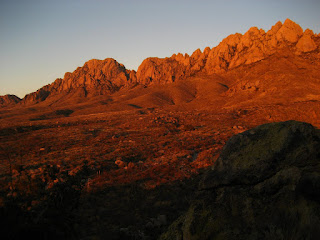
Now, two days later the Organs have finally been dusted by snow, beautiful and rugged as ever.

Special thanks to Ilana, Kurt and Alden. I just got the new back-pack you sent me for my birthday and Sunday was it's first day out. That is an awesome pack, and the pefect size for climbing in the Organs and rescue missions. Thanks!
We climbed Black Velvet first and I let Ben lead all the good parts. I haven't fdone this route in a while, but it felt like it could be done in a single long pitch if you take the slab finish instead of the roof traverse. Ben had a 70 m rope but we still broke the climb into three pitches and we never climbed past the half-way point. We took a little lunch break and then I led us up DWI. This route was just my style: easy 5.10 moves, just-enough pro where I felt secure, but spread out enough where I had to focus. It starts up a loose slabby face past 3 bolts to a roof. 2 of th 3 bolts are old button-heads. The move stepping up under the roof was thin and committing but once under the roof I could reach some large jugs above and pull up to a good stance. The route then follows up a thin crack until the crack becomes nothing more than a seam which doesn't take any pro. At that point I made a few moves to the right where I gained another crack which would take some gear. This crack petered out too at a small stance with two bolts (one new one old). Above this bolt looked pretty blank as far as protection was concerned but I could make out a series of face holds which looked pretty good. I followed these up and slightly to the right where it looked like there might be some pro in some diagonal slashes. Turns out there weren't any placements there, but there were some decent rest-stances and I was able to finish up the route with only a marginal small wire for protection during the last 20 ft. Looking at Mountain Project now, it appears I should have gone left at the last bolt and into a small crack system. Next time.

Ben Nadler rappelling DWI
What happened next blurs together somewhat, as dozens of people arrive and the team is mobilized to extract Trudy on a litter. John and Ben start first aid immediately and get Trudy more comfortable and warm as night falls. By 6 O'clock Trudy has been packaged up on the litter and various teams are scrambling below setting up rappel anchors to help get her down. The kind of extraction we were faced with is called Medium-Angle by experienced rescuers. This means that it is steep enough to make simply carrying of the litter extremely hazardous, but we are still able to walk/scramble down the trail. To mitigate the hazards, anchors are used to belay the litter down. The team has a humongous (and heavy) 100 m static rope which is attached to the litter to belay it down. The litter-carriers can then hang onto the litter and pull against the rope, which puts most of the weight of the subject on the rope. It's very similar to rappelling from a rock-climb, where you sit back and let your weight hang on the rope as you control your descent. The scale is much larger though, as the litter and six litter carriers can put a lot of weight on the system. Teams of people are furiously working below to make sure anchors are set up. Once the bottom of the rope is reached, a team of people quickly gather up the rope so it can be used below, and remove all the anchors above so that the webbing can be used below for the next a series of anchors. Medium-angle extraction requires a massive amount of coordination and effort. We had over 20 rescuers from both OMTRS and Mesilla Valley Search and Rescue helping and it took about 4.5 hours to get Trudy down the medium angle parts of the trail, as far as the "Yellow Rocks". We stopped here to allow the medics to start an IV and get Trudy full of fluids. We also tried to find a spot where a helicopter could land. From yellow-rocks to the top of Modoc mine rd, we carried Trudy out using the litter's wheel attachment to roll her on the trail. The end of the Modoc mine rd was our best bet for a helicopter landing spot, we reached it at 11pm. A helicopter was sent out from one of the hospitals and we cleared the landing zone and were ready to transfer her over, but the winds and terrain were too much for the pilot and they weren't able to land. We ended up loading Trudy into one of the team members vehicles, a tricked out Hum-Vee. Trudy was down to the main road and in an ambulance by midnight.
It's hard to briefly convey the amount of activity and effort that went into the rescue. We were fully mobilized for over 6 hours. We were a swarm of rescuers, head-lights bobbing up and down the mountain side. Everyone looking out for everyone else, and looking for ways that they can do the most good. At some points it was chaotic. Gear was being shuffled up and down the mountain side. One medic bag was carried up and down the trail twice due to communication misunderstandings. It wasn't uncommon for rescuers to be seen sliding down parts of the trail themselves, cursing and flailing. Collectively we must have carried out half of the habitats cactus thorns. But in the end we were a happy crew. We got Trudy out safely in the biggest mission that we've seen this year. We were tired, and sore, but content in a way that sustains volunteer organizations like ours.
Now, two days later the Organs have finally been dusted by snow, beautiful and rugged as ever.

Special thanks to Ilana, Kurt and Alden. I just got the new back-pack you sent me for my birthday and Sunday was it's first day out. That is an awesome pack, and the pefect size for climbing in the Organs and rescue missions. Thanks!
Subscribe to:
Posts (Atom)
